From individual contributor to leading research teams — on systems in millions of homes.
More than a decade of turning research into products — a recognition engine on millions of smart TVs, an on-device medical AI taken to market, and today an agentic platform for game studios. The model is rarely the hard part; the system around it is.

Agentic and foundation-model systems on Sweden's AI Factory.
At RISE I drive the AI transformation journey for startups and SMEs — from first use case to deployed system — and build agentic AI platforms on HPC infrastructure in the Sweden AI Factory, part of the EU network of supercomputing hubs.
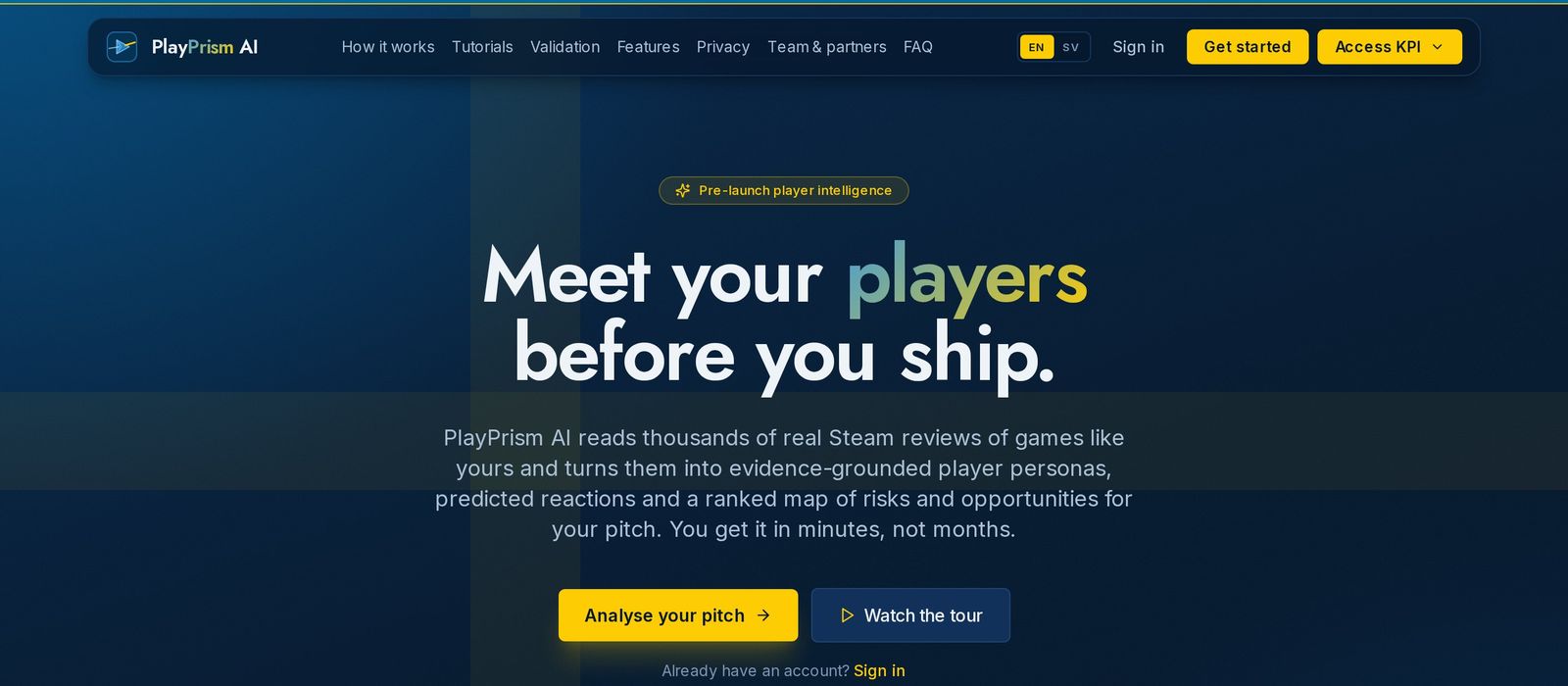
I am the architect and builder of PlayPrism AI, an on-premises platform where ten specialist agents turn game pitches and real Steam reviews into evidence-grounded player personas, predicted reactions and ranked product risks, with an authenticity gate validated against historical launch data.
- Own the multi-agent workflow, model stack, grounding architecture, evaluation gates and deployment.
- Resumable LangGraph pipeline on Qwen2.5-32B and BGE-M3, running on-premises and GDPR-ready.
- Multi-user studio platform with drill-down chat, validation reports and a one-page studio memo.
- Research alongside: DiA, a directional temporal adapter for video foundation models, at NeurIPS 2026.

A world-first on-device AI, taken from 82% to 94%.
After platform-scale machine learning, I wanted to put a model inside a physical device. The AUTION EYE AI-4510 automates urinalysis: a camera images a sediment sample and the model classifies what it sees, on the device itself.
I built and led a six-person research team to deliver the computer-vision methods inside it. The constraints were the opposite of Samsung: an embedded inference budget instead of a cluster, and a clinical workflow where every error matters.
- Custom ResNet classifiers and GAN-based super-resolution to recognize cells and microorganisms in low-quality microscopy.
- AI workflow on Microsoft Azure for edge deployment.
- Explored blood-glucose estimation and RNA-based early cancer detection.
- Two patent applications on AI-based biomarker discovery and medical image interpretation.
It is also where my PhD began: models that pass validation can still break on real samples. Can learned representations hold up in the real world?

Content recognition on millions of smart TVs.
I architected the visual-media recognition engine behind Samsung ACR — CNN and LSTM models for object and action recognition on live TV content, built on Samsung's fingerprinting — and reinforcement-learning ad recommendation for Samsung Ads.
The system scaled to 1,200 nodes on AWS and was deployed on millions of smart TVs in more than 15 countries. Over six years I grew from individual contributor to leading a team of 13 engineers and researchers, with three promotions along the way.
- Live TV program and channel identification, plus a family of computer-vision applications on broadcast content.
- MDP/POMDP-based ad targeting for commercial displays.
- Real-time streaming on high-availability big-data pipelines (Hadoop, Kafka, AWS).
- Dozens of patent applications and five granted patents, valued at USD 1.4M.
- Samsung Innovator of the Year 2017; Samsung Outstanding Performance awards 2015 and 2018.

Where it started: enterprise systems at scale.
I contributed to the SOA-based retail services platform for T-Mobile USA — a large enterprise backend in production retail workflows.
- Middleware components in Java/J2EE with RESTful services.
- Built the Ecosystem Health Monitoring System: automated platform status dashboards and alerting.
Research that leaves the lab.
From prototype to product
I have led the full transition from proof-of-concept to deployed AI — twice to market, once on millions of devices.
End-to-end ownership
Data engineering, model training, cloud and edge deployment, evaluation, and the IP that protects it.
Many stakeholders
Academia, industrial R&D, product managers, designers and end users — in Asia and Europe.