The research journey so far.
It started with a PhD on one question — can self-supervised representations hold up in the real world? — and has grown into adapting multimodal and video foundation models efficiently. Each project below is a deep dive into one paper — method, results and code.
Five years on one question: self-supervised learning powers every foundation model — does it hold up in the real world?
Self-supervised pretraining is the backbone of today's foundation models, from CLIP and DINO to the vision encoders inside multimodal LLMs. My doctoral work asked what happens to those representations outside the benchmark — under distortion, corruption, adversaries and unfamiliar domains — and how to pretrain them so they stay reliable.
DAAD AI-NET Fellowship — German Academic Exchange Service fellowship for AI research collaboration in Germany.
Visiting researcher, UCF CRCV — hosted by Prof. Mubarak Shah. SSBA magazine →
STARS member feature — Swedish Trans-Atlantic Researchers and Scholars network, for Möbius-MPD. Read →
Wallenberg grant
SASUF grant — South Africa – Sweden University Forum.
Machine Learning Summer School — University of Cambridge, UK (ELLIS).
INTSAM grant
Member — European Laboratory for Learning and Intelligent Systems.
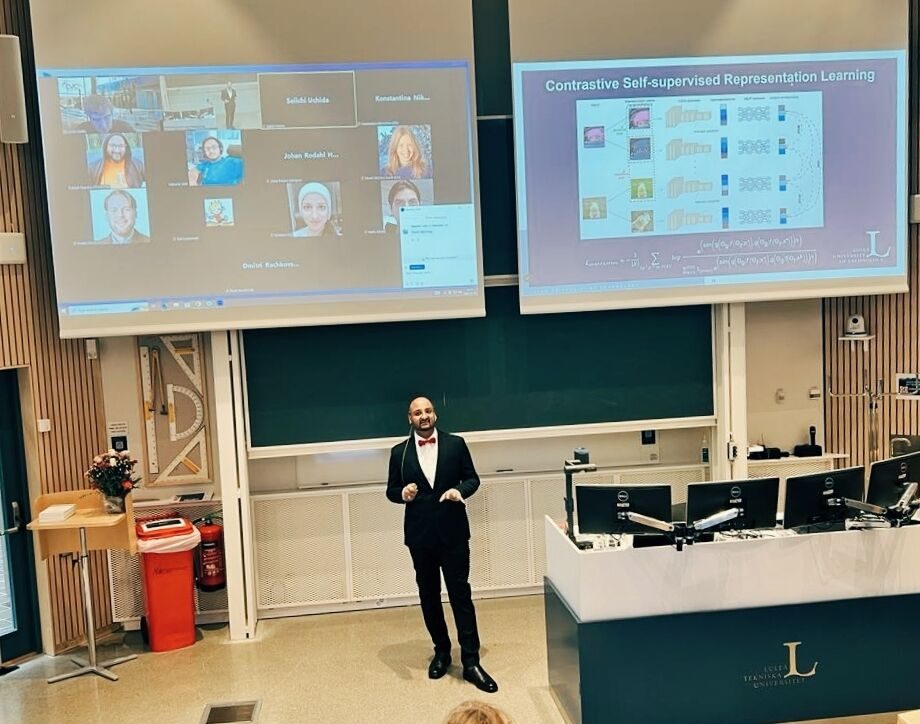
My PhD in Machine Learning at Luleå University of Technology, advised by Prof. Marcus Liwicki and defended publicly in April 2025, showed that self-supervised representations degrade sharply under real-world shift — and introduced methods that build robustness into pretraining itself instead of patching it afterwards.
It followed two threads. Robustness: adaptive adversarial self-supervision (ASTrA, ICLR 2025), the first camera-parameter-free model of perspective distortion (Möbius-MPD, ECCV 2024) and its lightweight successor (LCM, ACCV 2024), and systematic robustness audits of self-supervised and open-vocabulary models. Domain awareness: label-efficient self-supervision built for the structure of a domain — histopathology, mining, remote sensing and retinal imaging.
Adapting frozen models to time and place.
Most capability already sits inside frozen vision-language models. The research problem is the small, well-placed adapter that unlocks it for video, at a fraction of the cost of retraining.
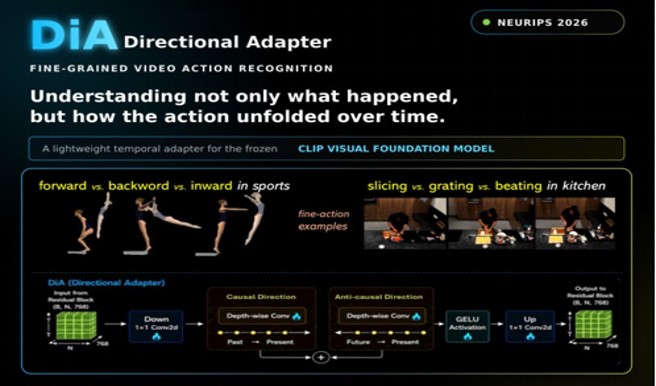
DiA: Directional Adapter
Separates causal and anti-causal temporal evidence inside a frozen CLIP model. RGB-only state of the art on seven video benchmarks.
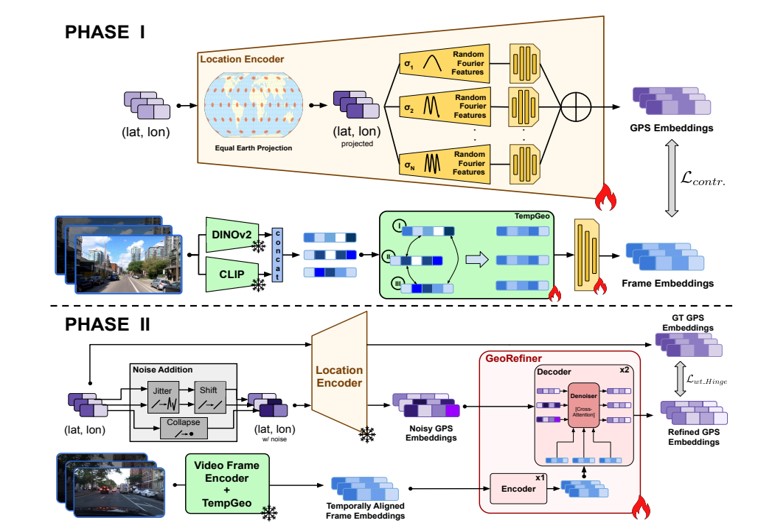
VidTAG
Temporally aligned video-to-GPS geolocalization at global scale, geolocating every frame with denoising sequence prediction.
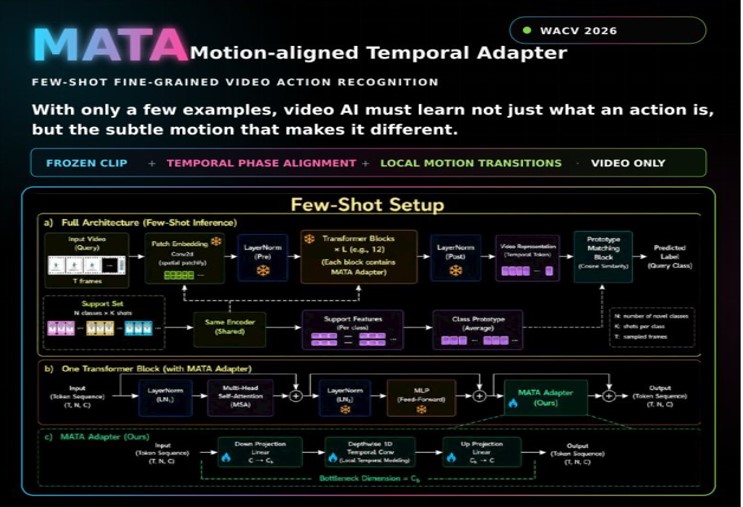
MATA: Motion-aligned Temporal Adapter
A parameter-efficient, practical adapter on a frozen CLIP ViT-B/16 for few-shot fine-grained action recognition.
Read the paper →Robustness learned in pretraining, not patched afterwards.
Adaptive adversaries, camera-free models of perspective distortion, and systematic audits of how self-supervised and open-vocabulary models break under shift.

ASTrA - Adversarial Self-supervised Learning with Learnable Attack Strategy
Read the deep dive →
Möbius Transform for Mitigating Perspective Distortions in Representation Learning
Read the deep dive →
Open Vocabulary Object Detectors- Robustness Challenges under Distribution Shifts
Read the deep dive →
Can Self-supervised Representation Learning Methods Withstand Distribution Shifts and Corruptions?
Read the deep dive →Learning where labels are scarce and expensive.
Self-supervised methods built for the structure of a domain — magnification in histopathology, depth in mining imagery, sensors in remote sensing — so models need a fraction of the labels.

Magnification Prior- A Self-Supervised Method for Learning Representations on Breast Cancer Histopathological Images
Read the deep dive →
Functional Knowledge Transfer with Self-supervised Representation Learning
Read the deep dive →
Depth Contrast - Self-supervised Pretraining on 3DPM Images for Mining Material Classification
Read the deep dive →